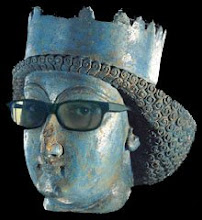
If you have never seen Time Bandits, you need to run (don't walk) to your local library/video store and get it, bring it home, and prepare to enjoy a fantastic film. Of course, this clip is a bit of a spoiler as it is the ending, but it really doesn't have a ton of bearing on the rest of the movie.
The question I am asking today is, does evil really exist? Is there such a thing as evil? Can evil ever really be "incarnate"?
I was reading a review of The Dark Knight (fantastic by the way... see it in IMAX if you can) and this was the question being asked. There is no such thing as darkness, just the absence of light. There is no "cold" only the absence of heat. Is evil like this? Does it actually not exist in and of itself? What if evil is just the absence of something else?
If that is the case, what is the "something else" that is missing when we experience things that are evil? I think "good" cannot possibly cover it. I have been in plenty of circumstances where good had no presence but I didn't experience evil. Ultimately, evil is the word we attach to anything that lacks love. Love is the thing that, when missing, makes evil seem so real.
But evil has no power of its own. Even if you think of a being like Satan or the devil as being evil, the truth is that he/she/it is actually the absence of God (who defines himself/herself as "Love"). There is no point in combatting evil. It is not a real thing. If we stop focusing on the experience of an absence and simply bring back the presence of that which is missing, evil will cease. As trite as this sounds, love really is the answer. We must choose to respond to the absence of it by bringing it with us rather than simply responding by continuing to dwell in love's absence. War is the absence of love. The way to end war and conflict is through love, not more war.
War: it's evil, don't touch it.
8/15/08
It's evil, don't touch it!


Rocky Mountain High
 So Kristy and I are heading for Durango, Colorado in the morning. I have been looking forward to this vacation for 3 months... ever since summer classes started and I had 12 straight weeks of 21 hours of classes to sit through each week, I have been pining to go to my in-laws' house in the mountains and sleep late, eat home-made soup and bread, and play scrabble.
There are two unfortunate parts about this trip.
1) The 'rents still use dial-up! This means posts might be few and far between since the closest town is 20 minutes away. I will write when I can.
2) Our dog can't come. We thought about letting her fly in the cargo section of the plane, but when we looked into it we heard horror stories of the area not being pressurized correctly and the dogs dying or the sheer stress of it killed the dogs. We are not willing to take that chance. She would be so much fun at their house. They are on the side of a mountain and Ellie would love running through the woods and chasing the squirrels. She adores my father-in-law also. But, we opted for having our friend, Guy, come and watch her. He is the one who wrote the post on Animal Theology I linked to a couple of weeks ago, so I'm pretty sure he values creation enough to care for our kid/dog for a week. Plus we paid him.
Hopefully I'll be able to get a couple of posts in this next week. If not, I'll be back on the 25th! Pray that a hurricane doesn't hit Jacksonville while we are gone.
8/13/08
Communion
 Also known as eucharist or Lord's supper. It is the oldest element of Christian worship. Although there are many Old Testament/Hebrew Bible/Tanakh allusions to the eventual sacrament of communion, it was fully established by Jesus at the Last Supper and has been THE staple of Christian worship for 2,000 years. Interestingly, in the past couple of hundred years many denominations have shifted the focus away from communion.
Here are a few of the basic disagreements regarding communion: symbol vs. sacrament, necessary elements, frequency, who can partake, and the ultimate purpose of it.
Again, I will show my hand at the start. I see communion as a sacrament (a rite that conveys grace, blessing, or holiness to the believer who participates in it). The elements are bread and wine (I am okay with grape juice as long as we understand that unfermented grape juice didn't exist until Welch's invented it). I am a proponent of it happening every week (even though my denomination usually only does it once a month). I think it should only be for those believers who have joined mystically with the Body of Christ (the Church universal) through baptism. I think the purposes of communion are:
1) Renew and strengthen the Church
2) Offer a sacrifice to God
3) Mystically connect with every other believer
4) Mystically connect with Christ
5) Point to the day when we will eat with God at the banquet table
I will now reveal more of my hand. Despite my seemingly strong and somewhat nit-picky beliefs, I also think that we must avoid the temptation to make it too formulaic. While I think there are proper ways of participating in communion, the goal is to participate. If you don't have wine or grape juice, use whatever you have. The point is to eat together. The point is to open up a place for Christ to be present. The point is to be strengthened. The point is to experience some of heaven on earth.
Christ said, "This is my body." Now, I am not much of a literalist, but I do believe that Jesus meant that in some way, he is Truly present in communion. Not just in the way that he is always there, but that in the act of the words being said, the elements being offered, and the people being gathered together Jesus is actually present. This is known as the real presence. Did you know that not only do Catholics and Orthodox believe this (Catholics define it as transubstantiation which means that the elements become the literal flesh and blood... the Orthodox do not have this defined the way Catholics do, but they are similar), but both Luther AND Calvin taught forms of the real presence? Luther taught consubstantiation. This means that Christ is present with the elements. Once the meal is done, he is not longer present. This is why he had a problem with the Catholic practice of eucharistic adoration. I don't have a problem with that practice since they are approaching it from the standpoint of believing that they are worshipping Jesus. If they believed he wasn't in the bread and still worshipped it, that would be idolatry, but it is not the way Catholics do it! Calvin said that Jesus was present in the meal by the preaching of the word and the blessing of the offering.
All three positions teach that grace is received through communion. Not the "saving grace" we think of when we normally hear the word grace (necessarily), but more the grace of experiencing God more and being further equipped because of the experience to love the world more. The position that it is merely symbolic loses this. It reduces the table to just a mere act of remembrance. While that element is definitely there ("do this in remembrance of me"), it is only the beginning. Again, as with baptism, stopping at the symbols is failing to see the bigger picture.
Because grace is conferred and the meal itself is unifying, there is absolutely no good reason not to do it every week (hell, the Catholics have it even better by doing it everyday)! Do we not want too much grace? Is too much unity unhealthy?
8/11/08
Baptism

 There are plenty more aspects to this issue than the argument between baptizing infants or baptizing "believers" only. There are disagreements over the method: sprinkling or full immersion. There are arguments about what actually takes place: purely symbolic, sacramental, or even actual forgiveness of sins (original sin included). Some even say that baptism in necessary for salvation while others would say that it is not.
The interesting part is that all of these positions have some biblical support. I know, some of you just blew a gasket. "How the hell does the Bible support baptizing babies??!!" or "HERESY! How dare you say that the Bible says baptism doesn't remove original sin!" But bear with me. Before I start any of this, I have to make one point. Walter Brueggemann (one of the world's foremost biblical scholars) suggests that it is impossible to interpret scripture completely free of bias. John Wesley said a similar thing long ago as well. I agree. Brueggemann says that we all interpret scripture based on 40 verses (or passages). We find the 40 that we like/agree with/can ascribe to, and then we sift all other passages through those verses. So, if one of your verses is Acts 2:37-38 then you will probably view all passages talking about baptism as having to do with people who believe, but also having to do with sins actually being forgiven and the Holy Spirit entering the life at baptism. However, if you like verse 39 more then you might think baptism is for children. We all have bias when approaching scripture. I do too. But this is my blog so I get to say what I think... lol.
First, is baptism for "believers only" or should the church baptize infants? I will start by revealing my position. I strongly believe that we SHOULD baptize infants. The arguments against are purely arguments of omission. The fact is, baptism is repeatedly compared with circumcision in the NT. A Jewish baby is traditionally circumcised on the 8th day. This circumcision makes that baby a member of Abraham's line. This takes placed based on the faith and heritage of the parents... the baby has no say in it. Now, if some one converts later in life to Judaism (traditionally speaking here), he is to be circumcised as an adult to enact the same effect.
Now, if baptism is simply an "outward sign of an inward faith" as many like to say, this analogy makes no sense. If the ingratiation into the Christian family has already taken place and baptism is merely the outward sign of that, then a baby doesn't need to be baptized. Unfortunately for those who believe this, circumcision meant more than just an outward sign. It was that as well, don't get me wrong, but it began the membership in the community. That boy was now a Jew for the rest of his life. No matter what, he had been claimed and that claim was based in the faith of his parents.
Nowhere does the Bible forbid infant baptism. In fact, a strong argument can be made that when "entire households" are baptized, infants would be included. Jesus warns NOT to hinder the little children from coming to him. And the strongest example of God acting in a person's life based on the faith of others is the story of the paralytic. A man is brought before Jesus by his friends. It is the faith of the friends that prompts Jesus to heal the man. The man does nothing! He could have chosen not to get up. He could have gone home and laid back down on his mat. Many who are baptized, even though they have experienced this healing from God based on the faith of their parents and the priest/pastor end up laying back down on their mat. If you lay down long enough, your muscles will stop working. Nevertheless, just because we do not choose to live in the truth, the truth is no less true.
Those who oppose infant baptism most likely ascribe to a more contractual form of salvation rather than covenantal. The problem is, there was no such thought of contractual salvation until Calvin (pretty much). The promises of God were passed from parent to child. Blood carried it, and blood delivered it. Jesus' blood was the instrument of the new covenant (not contract). A contract can only be entered into by those who are able to understand it. This is where we get an idea of an "age of accountability." A covenant, however, is passed on with or without our consent. Age of accountability is not found anywhere in the Bible. A key argument against infant baptism is that it is not explicitly found in scripture, but the same folks who make this argument ascribe to the "unscriptural" idea of an age of accountability. It is an interesting inconsistency.
But if it is covenantal instead of contractual, and if it actually begins something rather than just symbolize something that had already begun, then what actually happens at baptism and how do we get it to happen? I loathe reducing God (or the actions of God) to a formula. If I do A and B then God does C. It's bologna (I would use another word beginning with "b" if I didn't want to keep this family friendly). But, God promises that if, in faith (whether it be a "believer" or an infant brought before the community of believers) some one is baptized in the name of the Father and of the Son and of the Holy Spirit, then that person receives grace. That grace has many functions: it removes sin, it opens up space for the indwelling of the Holy Spirit, it initiates the person into the community, it begins the relationship with God. Now, again, there is an element of symbolism in this act, but there is so much more as well. The act does symbolize what happens inwardly. It also symbolizes the participant dying and raising again, just like Christ (and with Christ). But grace is present. It is sacramental. Something mysterious takes place and we lose that when we fear what we cannot completely understand.
So, does it have to be by immersion or is sprinkling okay? Well, all of the denominations that use sprinkling agree that the preferred method is immersion. But they all say that it is not the necessary form. What is necessary is: water, faith (again, either of the individual or the community for the individual), and the names of the Father, Son, and Holy Spirit. If immersion is the only way, why are there so many places in this world where that would be impossible? Does God not want people in the Sahara to be baptized? Do we have to spend money on building a pool in our sanctuary, or can we give that money to the poor and just use a little tub and sprinkle the water? God wants us to use our heads. I find it interesting that it is the people who ascribe to a purely symbolic baptism who also demand immersion. Which is it? Is the act just a symbol and thus, not really necessary, or is it more than that? It is more than that which is why God is just fine with freedom in the method. Again, only 3 things are said to be necessary (Jesus says unless a person is born of water and the Spirit... He does not say immersed in water): water, faith, and the three names of God.
Overall, when we reduce baptism to a symbolic act, we lose the mystery that accompanies it. When we close it to only those who believe, we block the saving power of the faith of others in our lives (just like the paralytic got to experience). When we limit it to immersion only, we reduce God to a formula. Baptism is about being a part of the new covenant, joining the family of that covenant, experiencing grace, receiving the Holy Spirit, allowing freedom to reign in our lives and the life of the church, and challenging the community to love this new member of their family. A baby dedication (also not found in the Bible the way those who practice it today do it) does not accomplish all of this and certainly does not bind the community together in covenant. It is just another line in contract. We need to move beyond the legal and into the familial. God is about relationships, not clauses.
8/10/08
Embracing the Past
 Christianity has such a rich tradition. Unfortunately, in an attempt to throw of the rules and regulations of the past in order to usher in a new age of freedom, we have thrown the proverbial baby out with the bath water.
So, for the next few blog posts, I plan on exploring different aspects of Christianity through (my own biased) historical and modern lenses. I plan on discussing baptism, communion, liturgy, meditation, evangelism (this one will be in a couple of parts: 1. method of salvation we communicate, 2. modes we use to communicate, pros and cons of these), church governance, and some others. This might be what you see in here for the rest of the month. I welcome any and all comments, criticisms, and "funnies" (as my wife calls them).
8/9/08
5 years!
 Apparently the 5 year anniversary is the "Wood" anniversary. So, today (August 9th), I am trying to find a good wooden gift to give my wife (view what she does all day here). Well, since marriages don't last as long as they used to, some people have tried to push for a modernization of the traditional anniversary gifts. Some are saying that 5 years is now the "Silverware" anniversary. Kristy says if I buy here silverware I won't be sleeping in the bed tonight.
I can't believe it has been 5 years. When we first got married, it was weird to sleep in the same bed with some one else. I had trouble falling asleep for a while. Now, it's weird when she's not there. When I turn 55 years old, I will hit the point where I will have been married longer than I was single. That is a long way off, and I think that my life already feels that real. She has been such a great partner, friend, confidant, and lover (yeah, I said it!). I know I am a lucky guy. Happy anniversary, Kristy (if you ever read this...). ;)
8/8/08
Hello (hello, hello) can anybody hear me?
 So that's twice this week my titles have quoted Pink Floyd. Is there some blogspot award for that?
I don't think even my wife reads this blog. I know that my friends Mike (formerly Mike-dogg) and Shelley have stopped by, but other than them I am not sure anyone is reading this.
Oh well, it's a good thing I am not really writing in here just about everyday for others. This has been a great outlet for me so far and my wife (again, who doesn't read this) doesn't have to endure my ramblings quite as much (unless she gets some alcohol in me).
Well, I will continue writing. I hope to get better. If you have any suggestions let me know.
I sure Wish You Were Here (hey, there's another Pink Floyd reference!).
Subscribe to:
Posts (Atom)